
OT Functional Capacity Assessments in Sydney
OT Functional Capacity Assessments: Boost NDIS IndependenceEmpowering Independence: OT Functional Capacity Assessments for Sydney NDIS Participants
OT functional capacity assessments ook at how a person manages everyday tasks, highlighting both strengths and areas where extra support or adjustments are needed. These assessments are tailored to the individual and aim to increase independence, safety, and overall quality of life.
Key benefits can include:
Improving daily living skills so people can work towards personal and health goals.
Building mental wellbeing, confidence and a stronger sense of control over day‑to‑day routines.
Expanding social, community and recreational participation by identifying practical strategies and supports.
Benefits for families and carers
FCAs also support family members, teachers and carers by explaining the person’s needs in clear, practical language. The assessment report can guide the whole support network to respond more consistently and effectively.
Examples of how FCAs can help supporters:
Personalised strategies to assist with everyday tasks such as self‑care, mobility, transfers and home routines.
Recommendations that reduce carer stress and burnout, such as additional support workers, respite or assistive technology.
Practical tools and communication approaches to manage behaviour, build routines and strengthen relationships.
What to expect in the FCA process
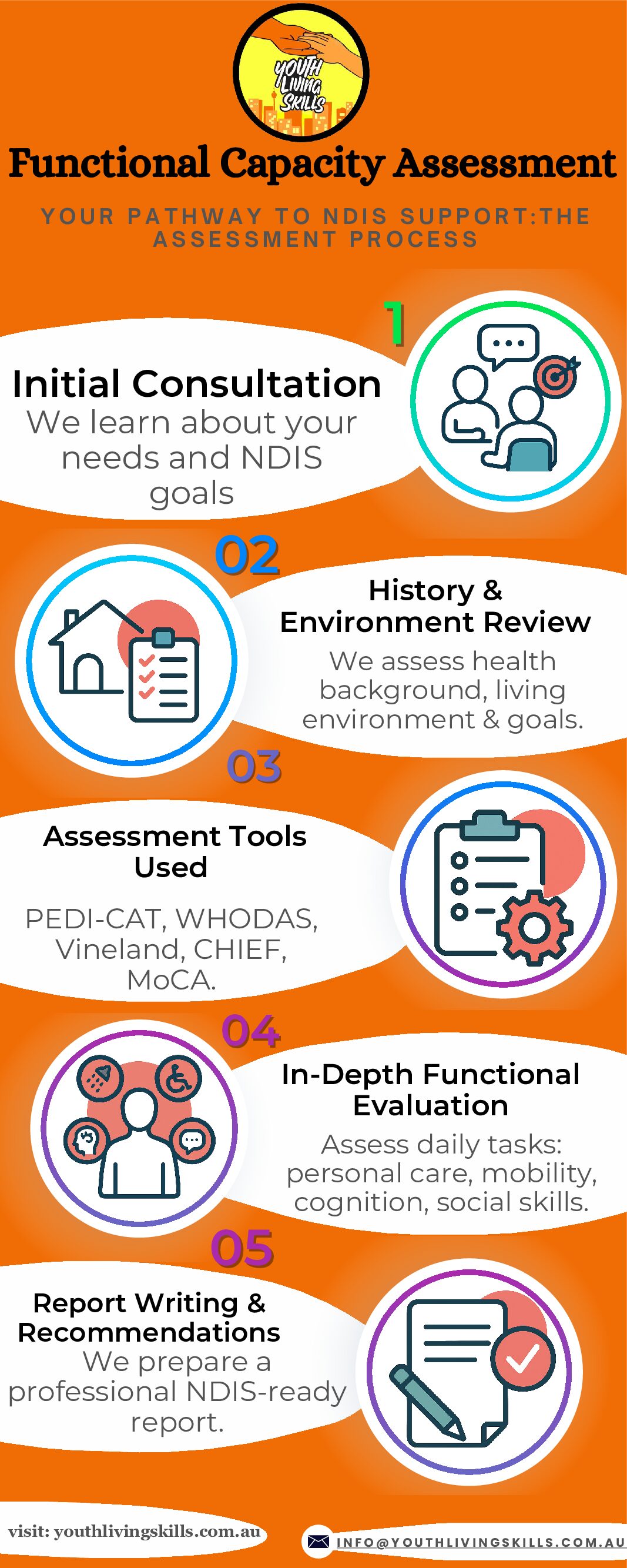
At the initial consult, the occupational therapist gathers information about health history, daily routines, current challenges, goals and NDIS requirements. This conversation helps form a clear picture of typical daily life and pinpoints areas where change would make the biggest difference.
The OT may then:
Observe everyday activities such as showering, dressing, cooking, mobility, communication and community access.
Consider physical, cognitive, emotional and environmental factors, including barriers at home, school, work or in the community.
Provide recommendations that promote skill-building and/or making shifts to the physical environment (e.g. at home or school) to mitigate key barriers.
Assessment tools commonly used
A core feature of FCAs is the use of standardised tools that compare a person’s functioning with typical expectations for their age group. These provide objective data that can strengthen NDIS funding applications and guide therapy planning
For children and young people (7–17 years), tools may include:
PEDICAT (Speedy) or PEDICAT ASD (Speedy) to assess mobility, daily activities, social/cognitive skills and responsibility.
Participation and Environment Measure for Children and Youth (PEM‑CY) to look at participation at home, school and in the community.
Vineland assessment to evaluate communication, daily living, socialisation and adaptive behaviour.
For adults (18+), tools may include:
If you or someone you know could benefit from an OT functional assessment, don’t wait. Reach out to our team of dedicated Occupational Therapists in Campbelltown to learn more about how we can help. Together, we can create a pathway to better health and improved quality of life.
Vineland assessment for adaptive functioning in communication, daily living and social skills.
Craig Hospital Inventory of Environmental Factors (CHIEF) to understand environmental barriers impacting participation.
WHODAS 2.0 (36‑item) to measure disability across domains such as mobility, self‑care and life activities.
Lower Extremity Functional Scale where lower limb issues affect walking and mobility.
Real-life examples
- A 13 year‑old student with mild intellectual disability may struggle with schoolwork, friendships and classroom routines; an FCA can highlight simple environmental changes and support strategies that boost confidence, independence and participation at school.
- An adult who has experienced a stroke may use an FCA report to secure NDIS funding for assistive technology, physiotherapy, OT and support workers, improving quality of life and easing pressure on family carers.
Getting the right supports early
Effective FCAs rely on collaboration between the person, their family, carers, teachers and other health professionals so everyone works from the same plan. By building a full picture of functional abilities and support needs, the assessment leads to tailored recommendations that help people move towards their goals.
Early referral for an OT functional capacity assessment can prevent issues from escalating and develop skills and resilience over time. For Sydney residents, accessing an FCA sooner means a better chance of obtaining appropriate NDIS supports and making meaningful progress in everyday life.
If you or someone you support might benefit from an OT functional capacity assessment in Sydney, get in touch with Youth Living Skills to discuss availability, referral options and next steps with a friendly local therapist.
Frequently Asked Questions
How can an OT functional capacity help people in Sydney?
An FCA can help Sydney residents by evaluating how people with disability achieve daily activities such as self-care, communication, mobility and social participation. The assessment examines areas of life where the person is independent, and support needs across the home, school, work or community settings. FCAs are useful to gain insights into someone’s everyday life to ensure that they receive care and supports in the most urgent areas.
What happens during the FCA?
The OT works with the individual and their family, carers and other supports to obtain a general understanding of their history, routines and current difficulties. Through observation, interview and completing standardised assessment tools, the OT can discern their cognitive, physical and emotional capacity to fulfil their desired goals and tasks.
How long does it take and what do I receive?
An OT functional capacity assessment usually involves a few hours of direct assessment plus additional time for information gathering and report writing, often totaling around 10–15 hours of professional time depending on complexity. The OT will then prepare a comprehensive written report that outlines functional abilities, key difficulties, and clear recommendations for NDIS supports, therapy, assistive technology and other services linked to your goals.
Contact Information
PO Box address:
PO Box 121, Glenfield NSW 2167