
OT Functional Capacity Assessments in Bankstown
Empowering NDIS participants in Bankstown with thorough OT functional capacity assessments to support funding, daily living goals and long-term independence
Suburbs in South-Western Sydney, such as Bankstown, have a high population of people living with disabilities, many of whom receive NDIS supports. A crucial factor in exploring individuals’ capabilities and areas requiring care and supports is thefunctional capacity assessment (FCA). These assessments are conducted by Occupational Therapists (OT) and often form the basis of NDIS funding and interventions.
The importance of FCAs
The vigor of the FCA is its focus on how the individual governs tasks in their daily life. By developing a general outlook of the person’s functioning, an appreciation for areas of strength, as well as fields where adjustments may be needed
OT functional capacity assessments look at how a person manages everyday tasks, highlighting both strengths and fields where alterations or supports are needed. FCAs aim to develop a highly personalised plan to help increase safety and self-governance.
Common key advantages include:
Strengthening everyday living skills so people can pursue their personal and health goals.
Increasing social, community and recreational involvement through practical strategies and supports.
Improving welfare of families and caregivers
While FCAs are primarily focused on the individual, the person’s family members and carers often also benefit greatly. As the assessments have a holistic approach, they can support family members, carers and teachers by helping them to better understand medical issues and their daily needs. Most importantly, the assessment can provide practical guidance about how the person’s support network can manage challenges more effectively and safely.
Examples of how FCAs can help families and carers:
Tailored strategies and environmental changes that can be made to reinforce daily and home routines.
Possibilities to ease carer stress and burnout, including extra support workers, respite options or assistive technology tools that may help.
Practical tools and communication techniques to manage behaviour, develop routines and strengthen relationships.
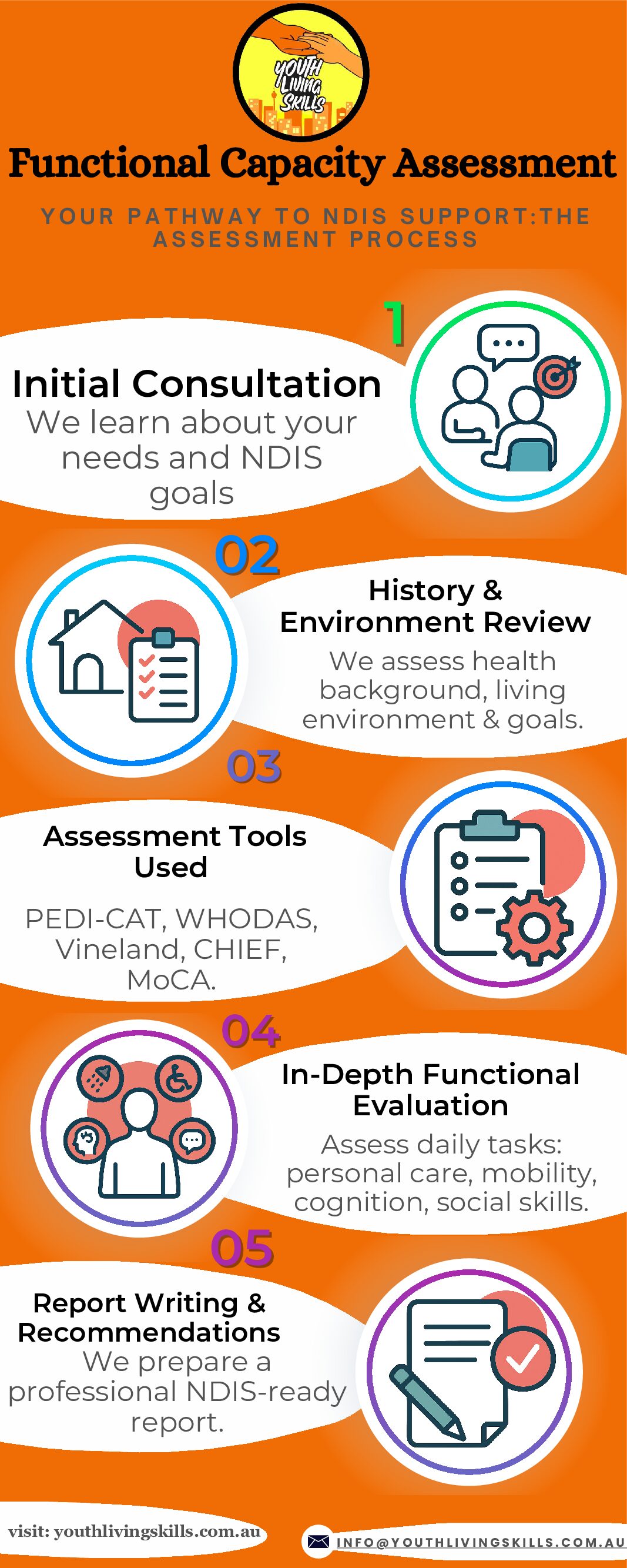
What to expect during the assessment
How the person manages activities of daily living, such as showering, personal hygiene, cooking, moving around, and community participation.
How the person manages activities of daily living, such as showering, personal hygiene, cooking, moving around, and community participation.
Ways that relevant parties (e.g. family, therapists, educators) can come together to implement plans in the most constructive and consistent manner.
Applicable recommendations that modify the physical environment and/or hone personal skills so the person can better cope with challenges.
Assessment tools commonly used
For children and young people (7–17 years), tools may include:
PEDICAT (Speedy) or PEDICAT ASD (Speedy) to assess mobility, daily activities, social/cognitive skills and responsibility.
Participation and Environment Measure for Children and Youth (PEM‑CY) to look at participation at home, school and in the community.
Vineland assessment to evaluate communication, daily living, socialisation and adaptive behaviour.
For adults (18+), common assessments used are:
Vineland assessment for adaptive functioning in communication, daily living and social skills.
Craig Hospital Inventory of Environmental Factors (CHIEF) to understand environmental barriers impacting participation.
WHODAS 2.0 (36‑item) to measure disability across domains such as mobility, self‑care and life activities.
Lower Extremity Functional Scale where lower limb issues affect walking and mobility.
Real- Life examples
- A 17‑year‑old student with mild intellectual disability may struggle with schoolwork, friendships and classroom routines. An FCA can highlight simple environmental changes and support strategies that boost confidence, independence and participation at school.
- An adult who has experienced a stroke may use an FCA report to secure NDIS funding for assistive technology, physiotherapy, OT and support workers, improving quality of life and easing pressure on family and carers.
Timely action sets the stage
Functional capacity assessments work best when the person, their family, carers, and other important support networks are involved, ensuring everyone is guided by a shared plan. By gaining a clear understanding of functional strengths, challenges and support requirements, the assessment generates tailor-made recommendations that support progress towards individual goals.
Seeking an OT functional capacity assessment early can help prevent concerns from worsening and builds skills and resilience over time. For people living in Bankstown, arranging an FCA sooner improves the likelihood of securing suitable NDIS supports and achieving meaningful change in everyday life.
If you or someone you care for may benefit from an OT functional capacity assessment in Bankstown, contact Youth Living Skills to talk with a local therapist about availability, referral pathways and the next steps.
Frequently Asked Questions
In what ways does an OT functional capacity assessment benefit individuals in Bankstown
An OT functional capacity assessment provides valuable insights for people living with disability in Sydney by reviewing how they manage essential tasks in their daily life, including personal care, getting around, interacting with others, and participating socially. The assessment identifies both the areas where a person is self-sufficient and those where extra assistance is needed, whether at home, school, work, or within the wider community. By offering a clear understanding of a person’s strengths and support requirements, FCAs ensure that individuals receive targeted help and resources where they are most needed.
What can I expect during the FCA?
The occupational therapist gathers information from the individual and their support network, using observation, interviews, and standardised assessments. Put all together, the OT can evaluate how well the person can manage their daily tasks and pursue their goals, whilst also informing how NDIS resources are best directed.
How long does it go for and what happens after?
When you have an OT assessment, the therapist spends about 10 to 15 hours on your case. This covers the time they spend meeting with you, as well as the time they spend writing your report and collaborating with your family, caregivers, and other people important in your care (e.g. teachers, therapists). The finished report will explain what you can do and where you need help. It also includes a plan for the equipment, therapy, and NDIS supports you need to reach your goals.
Contact Information
PO Box address:
PO Box 121, Glenfield NSW 2167